

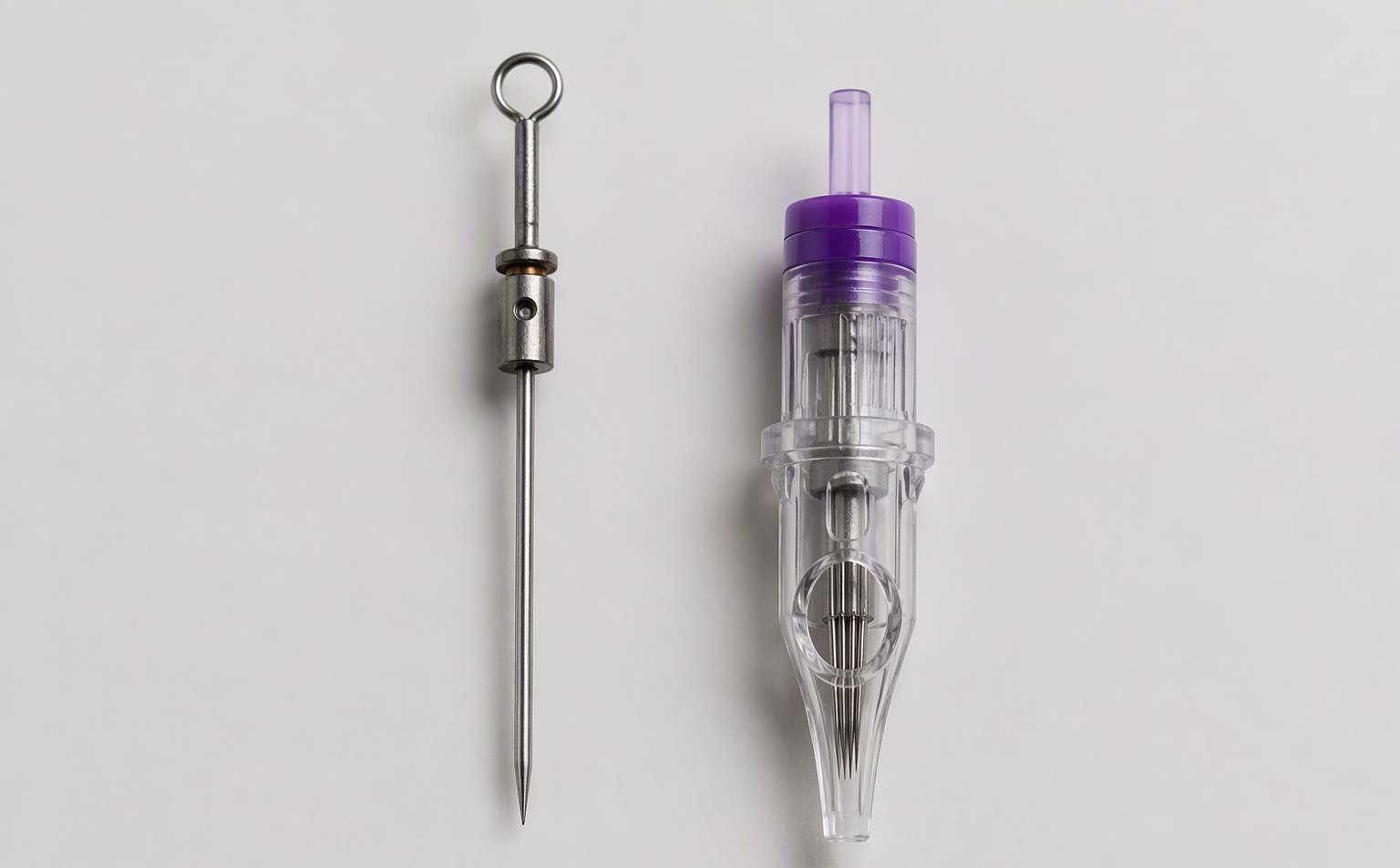
Walk into any tattoo convention and you will see two camps. One group works with pen machines and snaps in a fresh cartridge every few minutes. The other sits behind coil machines, threading needle bars through metal tubes and tightening grips with rubber bands. Same job, same ink, very different tools.
Full disclosure: at R&G Bio we make tattoo needle cartridges for a living, so you know where our business interests are. But we started in this industry when needle bars were the only option, and we still make them for some markets. So this is not a sales pitch. It is an honest look at how the two systems perform in daily work.
What Each System Actually Is
Before comparing performance, it helps to understand the physical difference. Both systems use the same needle steel. They just deliver it to the skin in very different ways.
Needles on Bar: The Analog Setup
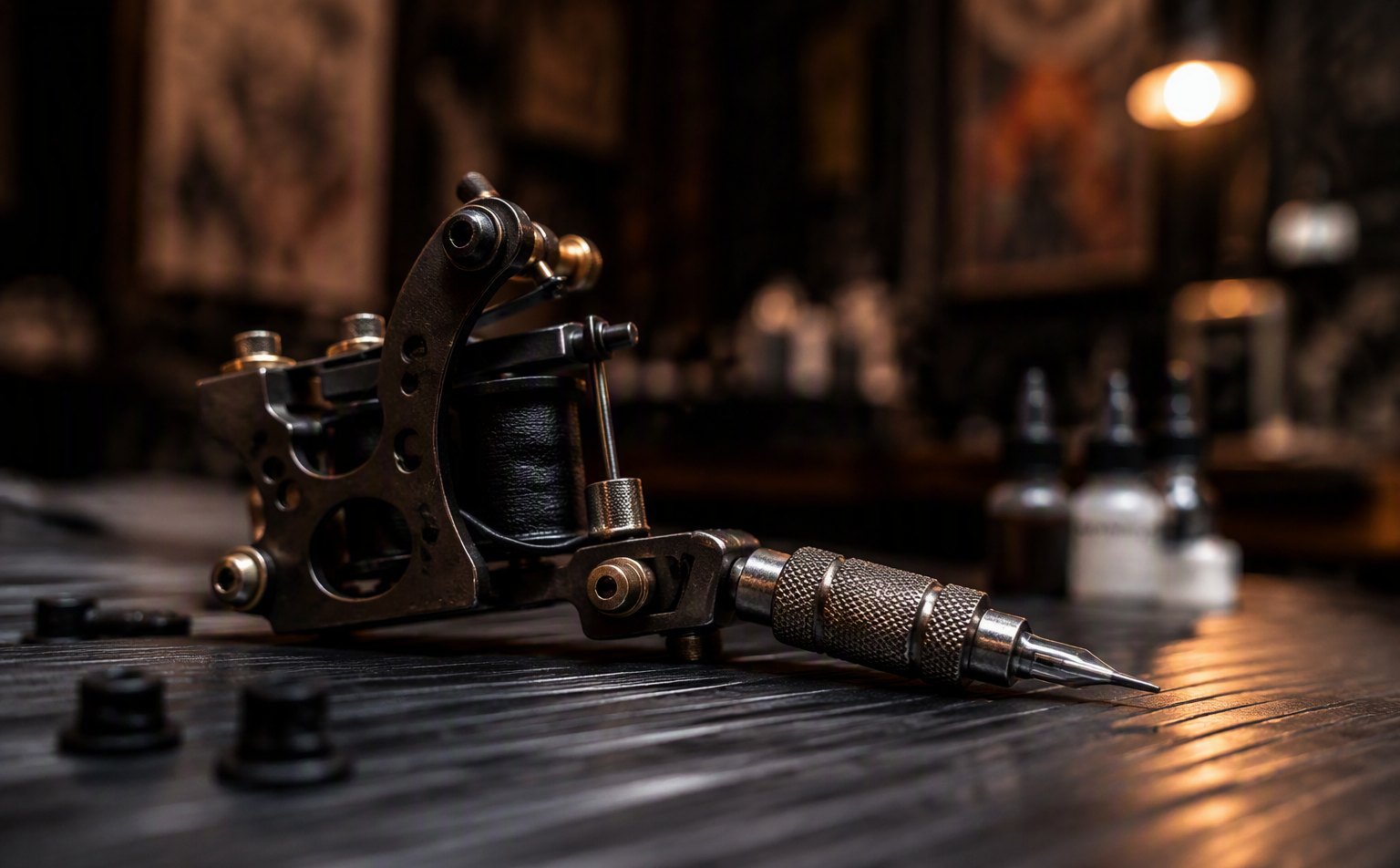
A traditional needle bar is a steel rod with needles soldered to the tip. The artist slides it through a reusable metal grip and tube and locks it in place with a rubber grommet. Depth is set by hand, by bending the bar or adjusting the contact screw. After the session, the grip and tube go into the autoclave and the bar goes into the sharps container. It works, but it takes mechanical know-how and strict hygiene discipline. >> See How to Install Tattoo Cartridges in 30 Seconds
Cartridges: The Integrated System
A cartridge is a self-contained unit. The needles sit inside a plastic housing with a built-in return spring and, in professional-grade units, a silicone membrane. You push the cartridge into the machine grip until it clicks. That is it. No rubber bands, no tube alignment, no bending bars. When you are done, you eject it and throw it away. The grip never touches ink or blood. In our factory we mold the housings from medical-grade polymer and assemble the needles in ISO Class 7 cleanrooms. The cartridge arrives sterile and leaves as bio-waste, and the machine never touches contamination.
Workflow Speed: Where Cartridges Win Hands Down
If you do multiple pieces a day, setup and teardown time matters. Cartridges were invented to solve a time problem, not an artistic one.
Switching Mid-Session
With cartridges, going from a 7RL liner to a 15RM curved magnum takes about five seconds. Pull one out, push the other in. With a traditional setup you are looking at a full teardown: remove the grip, unscrew the tube, discard the bar, unwrap a new one, thread it, align the tip, set the hang, attach the grommet, test it. Some artists keep three or four coil machines prepped just to avoid this. That is three or four machines instead of one pen.
Pre-Session Prep
Traditional needles need prep before the client even sits down: sterilized grips and tubes, ink caps lined up with the tube opening, and a workspace clean enough to handle loose needle bars safely. Cartridges arrive individually packed and EO-gas sterilized. You open one when you need it. There is no autoclave cycle to manage, no worn grommets to replace, and no tube diameters to match.
💡 Shop Owner Math
We ran a time study with a partner shop in Germany. Artists using cartridges averaged twelve minutes less setup time per session. Over a five-piece day, that is an hour of billable time back. For a shop charging 150 euros an hour, that is 750 euros of extra capacity a day.
Machine Compatibility: The Real Limitation
You cannot always switch just because you want to. The machine you own may have already decided for you.
Coil Machines: Built for Bars
Coil machines are built around needle bars. The armature bar hits the bar directly, and the whole magnetic cycle is tuned for that. Artists who love coils call it feedback: they feel the skin through the machine. If that is you, cartridges are not an easy switch. You would need an adapter, and even then the cartridge’s spring absorbs some of the punch a coil machine is built to deliver. Possible, but not great.
Rotary and Pen Machines: Built for Cartridges
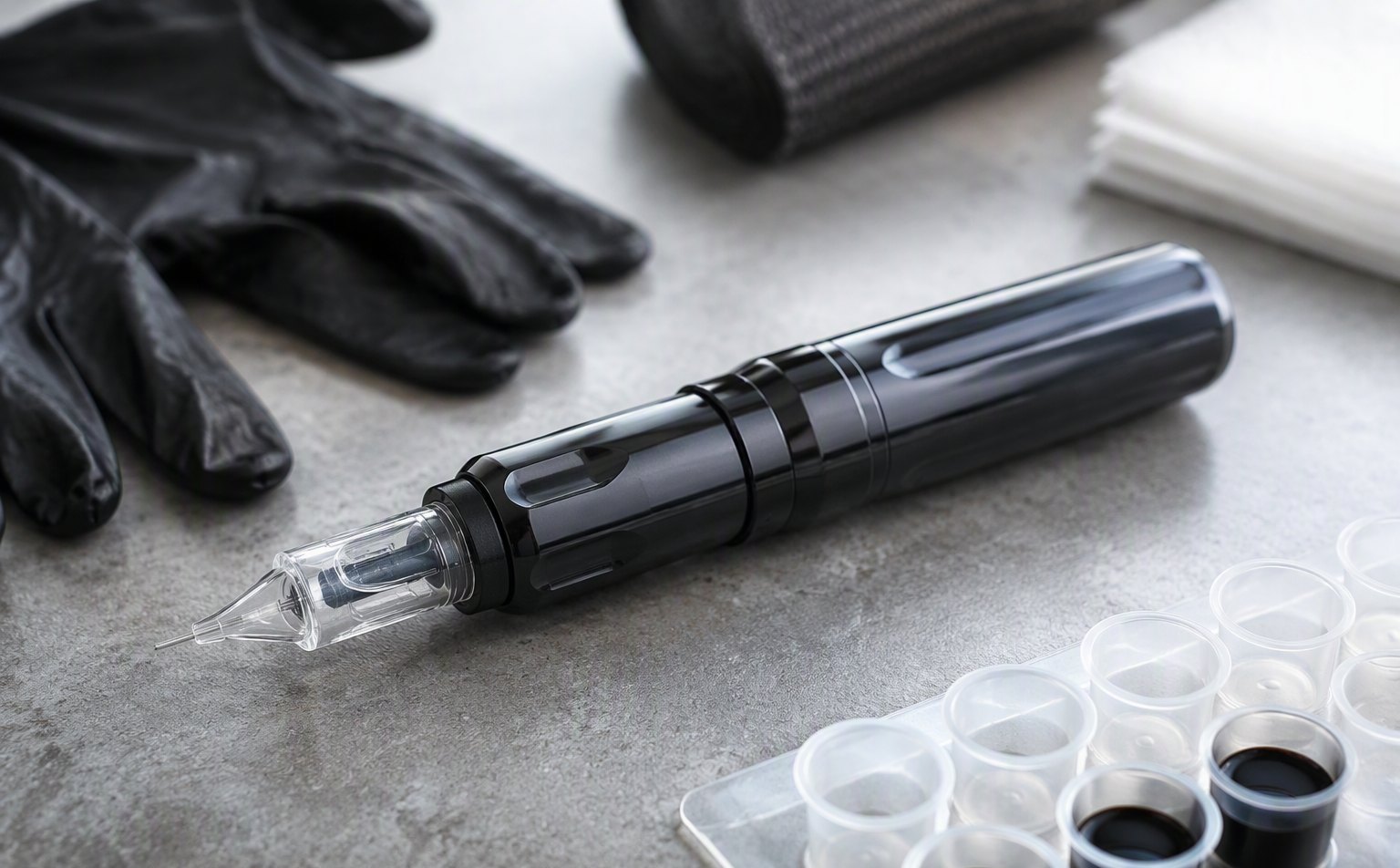
Modern rotary and pen machines are built for cartridges. The grip has a slot that takes the cartridge housing, and the motor drives the needle straight through it. No armature bar, no rubber bands, no alignment guesswork. Most machines sold in the last five years work this way. If you bought a new machine recently, it almost certainly takes cartridges.
⚠️ Compatibility Trap: Do not assume every cartridge fits every machine. The two common standards are Cheyenne-type (most European and Asian pens) and standard twist-fit (many rotaries). We make both. Check your machine manual before you order in bulk.
Hygiene and Safety: The Membrane Difference
This is where the topic stops being about preference and becomes about responsibility. How a needle system handles contamination decides whether it belongs in a licensed studio.
The Safety Membrane
A professional cartridge has a silicone membrane behind the needles. When the needle retracts, the membrane seals the housing, so ink and blood cannot travel back into the grip. One small piece of silicone doing a huge job. Without it, every needle stroke creates suction that pulls fluid up the tube. A traditional needle bar has no barrier at all. If blood travels up the bar, it reaches the machine. And unless the whole machine is sterilized between sessions, which is practically impossible, the next client is exposed.
We put a membrane in every cartridge we make. It is not a premium add-on. It is standard. We test the seal on every production batch, and if one membrane fails the backflow test, the whole lot is rejected. That costs us money. It is still cheaper than a cross-contamination problem landing on a distributor’s desk.
Disposable vs. Reusable Components
Traditional setups rely on reusable metal grips and tubes that must be scrubbed, bagged, and autoclaved after every session. Done right, it works. It is also where things go wrong: a rushed apprentice skips the ultrasonic bath, an indicator strip never gets checked, a grip looks clean but hides contamination in a tiny crevice. Cartridges remove this whole chain of risk by making the entire needle path disposable. The grip never touches the client. The cartridge never touches the next client. Closed loop.
💡 For Health Inspectors
Several of our European distributors tell us health inspectors now prefer cartridge-based workflows during licensing audits. Traceability is simpler, the contamination path is shorter, and the paperwork is lighter.
Cost Reality: Price Per Unit vs. Total Cost of Working
Here is where traditional needles look cheaper on paper and cartridges win on the actual balance sheet. You have to look at the whole picture.
The Hidden Expenses of Traditional Needles
A needle bar costs roughly fifty to seventy cents. But you cannot use it alone. You need a grip, a tube, grommets, autoclave pouches, indicator strips, and the labor to clean, wrap, and sterilize it all. Add that up and the real cost per session is far higher than the sticker price of the bar.
Cartridge Economics
A professional cartridge costs two to four times more than a needle bar. But that price includes the housing, the spring, the membrane, and the sterile packaging. The grip is reusable and never touches the client, so it does not need sterilizing between sessions. Setup takes seconds, and teardown is one ejection into a sharps bin. We price our wholesale cartridges to compete on total session cost, not unit cost. If you are a distributor explaining this to artists, lead with time saved and autoclave costs avoided.
Here is a quick per-session comparison, based on averages from our distributor network in North America and Europe.
Traditional Setup Per Session: ~$8-12 (needle + tube + grip + autoclave amortization + labor)
Cartridge Setup Per Session: ~$6-9 (cartridges used + minimal grip cleaning)
Performance and Feel: The Subjective Battle
Numbers are easy. Feel is not. Some experienced artists will never switch, because physical feedback matters more to them than convenience. Fair enough.
Stability and Side-to-Side Play
A needle bar runs through a metal tube that stops sideways movement. Rigid and simple. A cartridge suspends the needle in a plastic housing with a spring, so if the tolerances are loose or the grip does not seat it tightly, the tip wobbles. That is not a cartridge problem. It is a quality problem. We hold our housing molds to within 0.05mm and test every batch for sideways play under vibration. Cheap cartridges wobble. Well-made ones do not. If an artist tells you cartridges feel unstable, they used bad cartridges.
The Feedback Argument
Coil artists talk about the punch they feel when the needle enters the skin. The skin’s resistance travels straight up the bar into the hand. Cartridges soften that, because the internal spring absorbs some of the impact. Some artists prefer it, since their hands fatigue less over long sessions. Others feel disconnected from the skin. There is no right answer. It is preference built over thousands of hours with one tool or the other.
⚠️ The “Feel” Myth: Distributors often tell us artists prefer bars because the feedback is better. That is half true. Artists prefer bars because they learned on bars. Give a new artist a cartridge from day one and they will develop the same sensitivity through the housing. It is training, not physics.
Who Should Use What: A Practical Decision Tree
After seventeen years of making both systems, here is how we advise distributors to present them.
💡 The Hybrid Artist
A lot of the artists we supply use both. Coil machine with bars for bold outlines, rotary pen with cartridges for shading and detail. If you are a distributor, do not frame it as either-or. Stock both and let the artist decide per session.
About R&G Bio and Our Product Range
R&G Bio has been making tattoo and PMU needle cartridges since 2009. Our factory in China runs under ISO 13485 quality management, with ISO Class 7 cleanrooms, CE Mark, FDA registration, and KFDA approval. All needles are 316L surgical stainless steel, and all housings are medical-grade polymer. Every unit is EO-gas sterilized, individually packed, and fully traceable by batch.
Our standard catalog covers Round Liner (RL), Round Shader (RS), Magnum (M1), Curved Magnum (RM), and Bugpin configurations across #08, #10, and #12 gauges. We also do OEM/ODM for distributors and brand owners, with minimum orders starting at 20,000 units. Custom configurations, taper profiles, and packaging are all within our production capability.
Request a Quote or Sample Pack
If you are comparing cartridge suppliers, ask us for a sample pack. It covers a spread of our most popular configurations. Test them on practice skin, compare them with your current supplier, and judge the build quality before you commit to a wholesale order.
Final Word
So, which one wins? Cartridges win on speed, hygiene, and convenience. Needle bars win on raw feedback and coil compatibility. Most artists under forty have switched. Most artists over fifty who learned on coils have not. The market is moving to cartridges because the economics and safety rules push that way, but there is no shame in the old way if it fits your machine and your hand. We make cartridges because that is where the demand is. We respect the needle bar because that is where the craft started. If you are deciding what to stock, our honest advice is this: stock both, point new artists toward cartridges, and let the traditionalists keep their coils.